
Egyptian blue lotus explained: history, flowers, resin and extracts
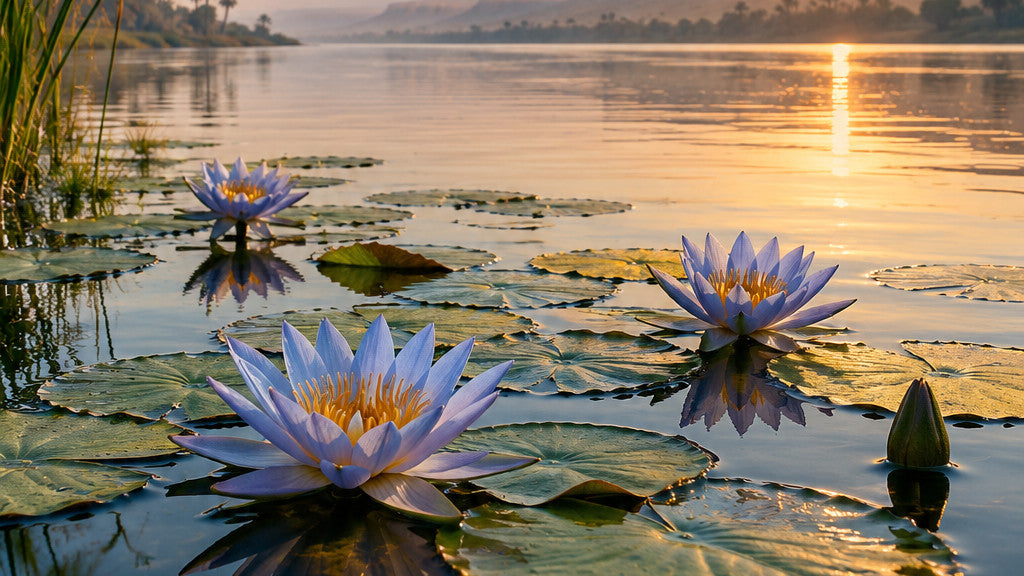
Egyptian blue lotus and blue lotus are the same plant: Nymphaea caerulea, a water lily native to the Nile. It turns up all over ancient Egyptian art, and it is one of the two biggest families on our shelf, alongside kanna.
It is a water lily, not a lotus
The name is a historical muddle. True lotuses belong to a different genus, Nelumbo, and the sacred lotus of India and Asia is one of those. The blue lotus of Egypt is a water lily: its round leaves lie flat on the water, where a true lotus holds its leaves and flowers up on tall stalks.
Why Egypt painted it everywhere
The flower opens with the morning light and closes again later in the day. To the ancient Egyptians that rhythm tied it to the sun, and to rebirth, and you find it again and again in their temple carvings, tomb paintings and sacred texts. People are often shown holding a single bloom up to the face to take in its scent.
What the research says
Blue lotus has had far less study than its reputation suggests, so this part is short.
- Egyptian art as a record of its effects. In 1981 the botanist William Emboden compared water lily imagery in ancient Egyptian and Maya art. He argued that both cultures used the flowers in ritual for their effects, not only for their scent, and that some of the art reads differently once you see it that way. Emboden, Journal of Ethnopharmacology, 1981.
- Nuciferine in the lab. A 2016 study mapped how nuciferine, one of the flower's natural alkaloids, acts on serotonin and dopamine receptors, in cell tests and in mice. The nuciferine in that study came from the sacred lotus, which carries the same compound. Farrell et al., PLoS One, 2016.
- No human trials yet. People mostly talk about blue lotus for winding down in the evening, but there are no controlled human studies of it, so that part is anecdote.
One flower, five forms
On our shelf, blue lotus comes in a few different forms, and the differences are mostly about how much of the plant you are holding and how it has been prepared.
Whole flowers are the dried blooms, the closest thing to the plant as it grew. They come whole, chopped, as petals or as powder.
Petals are A-grade petals on their own, without the centre of the flower.
Resin 50X is a soft, highly concentrated resin made from the flower.
Standardised extracts are measured by nuciferine, one of the flower's natural alkaloids. Each batch is HPLC tested, and the percentage on the label is what the test found: 4%, 10% and 98%.
Blends pair blue lotus with other ceremonial botanicals, such as our blue lotus and mugwort blend.
Reading a label
If a blue lotus product gives you a percentage, check what it is a percentage of. A nuciferine figure from an HPLC test is a measured number. A ratio such as 50X describes how concentrated the resin is. Both are useful, but they are not the same kind of number, so they are not directly comparable.
Everything in the blue lotus range is sold for ceremonial, educational and collection purposes.
Traditional, historical and published research information only. Nothing here is medical advice, and none of these botanicals are intended to diagnose, treat, cure or prevent any condition.